
2026-04-17 · basics, health, shopping
Updated: 2026-10-14
By InsuraFAQ Editorial Team · Reviewed for accuracy

Copay vs Coinsurance vs Deductible
Key takeaways
- A deductible is the amount you may pay for certain covered services before your plan starts sharing costs.
- A copay is a fixed amount your plan may charge for a covered service, such as a doctor visit or prescription.
- Coinsurance is a percentage of a covered service’s allowed amount that you may pay after meeting your deductible.
- Covered in-network deductibles, copays, and coinsurance generally count toward your out-of-pocket maximum, but the plan’s Summary of Benefits and Coverage controls.
Introduction
The short answer: a deductible is an amount you may pay before a plan shares the cost of some covered services; a copay is a set dollar amount for a service; and coinsurance is your percentage of an allowed amount. A single plan can use all three, but the rule for a particular service depends on its benefits, network, and Summary of Benefits and Coverage (SBC). CMS’s uniform glossary defines these terms.
Understanding the difference can help you compare plan designs and anticipate costs. This guide explains each term, shows one illustrative calculation, and flags the plan details worth checking before you rely on an example.
At a glance
In one line each:
- Deductible: an amount you may pay for certain covered services before the plan begins sharing their cost.
- Copay: a flat fee (for example, $30) you may pay for a covered service, such as a doctor visit or prescription.
- Coinsurance: your percentage of a covered service’s allowed amount (for example, 20%), often after a deductible is met.
All three add up toward your annual out-of-pocket maximum, the cap after which your plan pays 100% of covered costs.
Quick worked example (illustrative, not a plan rule). Suppose a plan has a $2,000 deductible, 20% coinsurance, a $30 primary-care copay, and a $6,000 out-of-pocket maximum. If you have a $4,000 covered, in-network procedure early in the year before meeting the deductible, it could work like this:
- You pay the first $2,000 of the bill, which satisfies your deductible.
- On the remaining $2,000, you pay 20% coinsurance = $400, and your insurer pays the other $1,600.
- Your total for the procedure is $2,400. If your plan applies a $30 copay to a later routine office visit, you would pay that amount for the visit.
- Eligible in-network cost sharing counts toward your $6,000 out-of-pocket maximum. Once you reach that cap, the plan pays 100% of covered in-network benefits for the rest of that plan year.
Quick Comparison
| Term | What It Is | When You Pay It | Example |
|---|---|---|---|
| Deductible | An amount you pay for certain covered services before the plan starts sharing costs | Until you meet the plan’s deductible, if one applies | You pay the first $2,000 of allowed costs for services subject to the deductible |
| Copay | A fixed amount for a covered service | When you receive the service, if your plan sets a copay | $30 for an in-network primary-care visit |
| Coinsurance | Your percentage of a covered service’s allowed amount | Often after the deductible, if the plan uses coinsurance | You pay 20% of a $10,000 allowed charge ($2,000); the plan pays the other 80% |
Deductible Explained
Your deductible is the amount you may pay for certain covered services before your plan begins paying its share. What is subject to the deductible, and what happens after you meet it, depends on the plan’s benefits and network rules.
How it resets. Deductibles commonly reset at the start of a plan year, which may be January 1 or another renewal date. Amounts paid in a prior plan year generally do not carry over.
Individual vs. family deductibles. A family plan may have individual and family deductible amounts. How either amount affects a family member’s cost sharing depends on the plan; check its Summary of Benefits and Coverage.
Not everything requires a deductible. Many plans cover preventive care (annual physicals, vaccinations, screenings) with no deductible. Some plans also apply copays to certain visits before the deductible is met.
For a deeper look at how deductibles work across all insurance types, see the insurance deductible explainer.
Copay Explained
A copay (short for copayment) is a fixed dollar amount you pay each time you receive a specific service. Unlike coinsurance, a copay does not change based on the total cost of the service.
Common copay amounts:
- Primary care visit: $20 to $40
- Specialist visit: $40 to $75
- Urgent care: $50 to $100
- Generic prescription: $10 to $25
- Brand-name prescription: $30 to $60
When copays apply. Many plans charge copays for routine services even before you meet your deductible. This means you can see your doctor or fill a prescription without first paying hundreds or thousands of dollars. However, this depends on your specific plan. Some high-deductible plans require you to meet the deductible before any copays apply (except for preventive care).
Copays vary by service. Your plan’s Summary of Benefits and Coverage lists the copays, if any, for different types of care. A specialist visit can have a different copay from a primary-care visit.
Coinsurance Explained
Coinsurance is the percentage of a covered medical bill you pay after you have met your deductible. Your insurer pays the remaining percentage.
Common coinsurance splits:
- 80/20: The insurer pays 80%, you pay 20%
- 70/30: The insurer pays 70%, you pay 30%
- 60/40: The insurer pays 60%, you pay 40%
The first number is your insurer’s share; the second is yours.
When it kicks in. Many plans apply coinsurance after you meet a deductible, but plan designs vary. The Summary of Benefits and Coverage shows whether a service has a deductible, copay, coinsurance, or another cost-sharing rule.
It continues until your out-of-pocket maximum. For covered in-network care, you generally keep paying the plan’s required cost sharing until your eligible spending reaches the annual out-of-pocket maximum. The plan then pays 100% of covered in-network benefits for the rest of the plan year.
How They Work Together
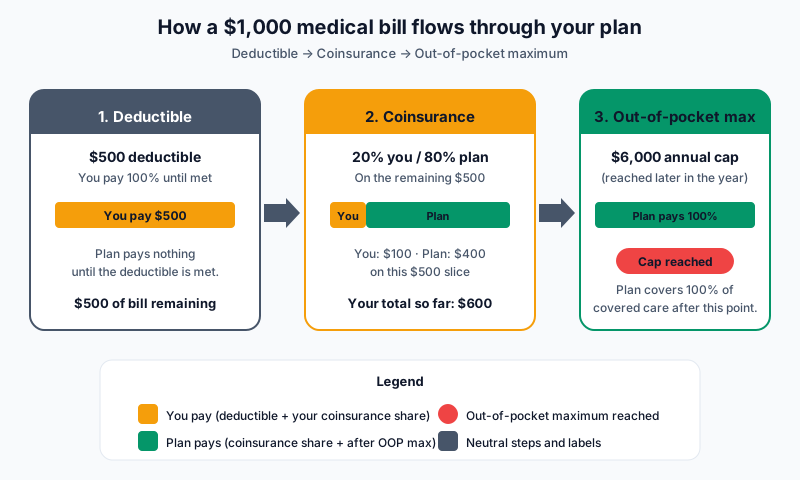
Here is a step-by-step example showing how all three cost-sharing mechanisms interact on a single plan.
Your plan:
- Annual deductible: $2,000
- Copay for PCP visits: $30
- Coinsurance: 20% (you) / 80% (insurer) after deductible
- Out-of-pocket maximum: $6,000
Scenario: You have a $5,000 medical bill early in the year (deductible not yet met).
- Deductible phase. You pay the first $2,000 of the bill. Your deductible is now met.
- Coinsurance phase. The remaining $3,000 is split according to your coinsurance rate. You pay 20% of $3,000 = $600. Your insurer pays 80% of $3,000 = $2,400.
- Your total for this bill: $2,000 (deductible) + $600 (coinsurance) = $2,600.
Throughout the year, eligible in-network copays, deductible payments, and coinsurance can accumulate toward your $6,000 out-of-pocket maximum. Confirm what counts in your plan documents.
What Is an Out-of-Pocket Maximum?
The out-of-pocket maximum (sometimes called an out-of-pocket limit) is the most you pay for covered in-network benefits in a plan year. Once eligible spending on deductibles, copays, and coinsurance reaches that cap, the plan pays 100% of covered in-network benefits for the rest of the plan year.
Key details:
- For 2026 Marketplace plans, the federal out-of-pocket limit cannot exceed $10,600 for an individual or $21,200 for a family. HealthCare.gov explains the 2026 limit.
- Premiums (your monthly payment for the plan) do not count toward the out-of-pocket maximum.
- Out-of-network costs may not count toward your maximum, depending on your plan.
- The out-of-pocket maximum resets each plan year along with your deductible.
This cap is one of the most important protections in any health plan. It means that even in a year with major medical expenses, your costs are limited.
How to Choose Between Plan Types
Understanding cost-sharing helps you pick the right plan structure.
High-deductible health plans (HDHPs):
- Higher deductible, lower monthly premium
- Paired with a Health Savings Account (HSA), which lets you save pre-tax money for medical expenses
- Best for people who are generally healthy and want to save on premiums while building a tax-advantaged medical fund
Low-deductible plans (traditional PPO/HMO):
- Lower deductible, higher monthly premium
- Copays for most services from day one
- Better for people who use medical services frequently or want more predictable costs
To compare plans effectively, estimate your total annual cost: 12 months of premiums plus likely out-of-pocket costs based on your expected medical usage. A plan with a lower premium may cost more overall if you end up paying a large deductible. For a side-by-side breakdown of plan types, see types of health insurance plans.
For more guidance on comparing policies, read how to compare insurance quotes.
Frequently asked questions
Does my copay count toward my deductible?
It depends on your plan. Some plans count copays toward the deductible, but many do not. Copays almost always count toward your out-of-pocket maximum. Check your plan’s summary of benefits for details.
What happens after I hit my out-of-pocket maximum?
Your insurer pays 100% of covered services for the rest of the plan year. You still owe your monthly premium, and out-of-network services may not be covered at the in-network rate.
Do all plans have coinsurance?
No. Some plans use copays only (with no coinsurance), while others use coinsurance only. Many plans use a combination. The plan’s summary of benefits will specify which cost-sharing method applies to each type of service.
Which is better, a low deductible or a low copay?
Neither is universally better. If you rarely visit the doctor, a high-deductible plan with lower premiums may save you money. If you have ongoing prescriptions or frequent specialist visits, a plan with low copays might be cheaper overall. Add up projected annual costs under each option to compare.
Is coinsurance the same as a copay?
No. A copay is a flat dollar amount (like $30 per visit). Coinsurance is a percentage of the total bill (like 20% of a $5,000 procedure). Coinsurance costs vary based on the size of the bill; copays stay the same.
Do vision insurance plans use copays or coinsurance?
Vision plans typically pay a fixed per-service benefit rather than splitting costs by percentage. That means a covered eye exam, lenses, or frames usually costs you a flat dollar amount at the point of care (similar to a copay), and the plan pays the rest up to its published limit. This is a different cost structure than the deductible-then-coinsurance model used by most medical plans. See our guide to vision insurance for what standalone plans cover and how the benefits are structured.
Next Steps
- Review your current plan. Look at your summary of benefits and identify your deductible, copay amounts, coinsurance rate, and out-of-pocket maximum.
- Estimate your annual costs. Add up expected premiums, likely copays, and potential coinsurance to compare plans realistically.
- Check enrollment deadlines. Open enrollment is the main window to switch plans. See the health insurance enrollment guide for key dates and steps.
- Compare quotes. Use the same coverage scenario across multiple plans to see which one costs less overall. Read more in health insurance cost.